
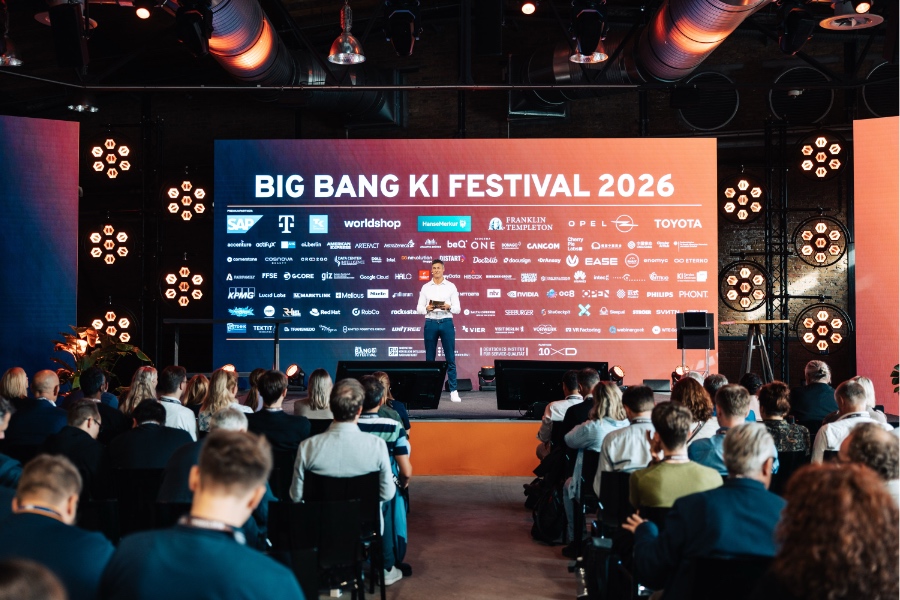
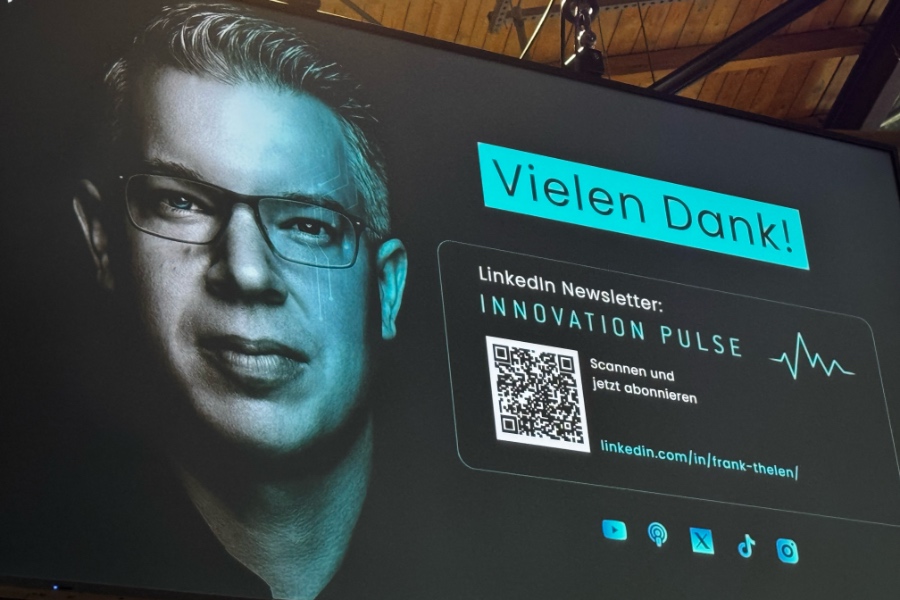
Two days of artificial intelligence, more than 11,000 visitors and names such as Markus Söder, Christian Wulff, Frank Thelen, Richard David Precht, Eckart von Hirschhausen and Jan Josef Liefers.
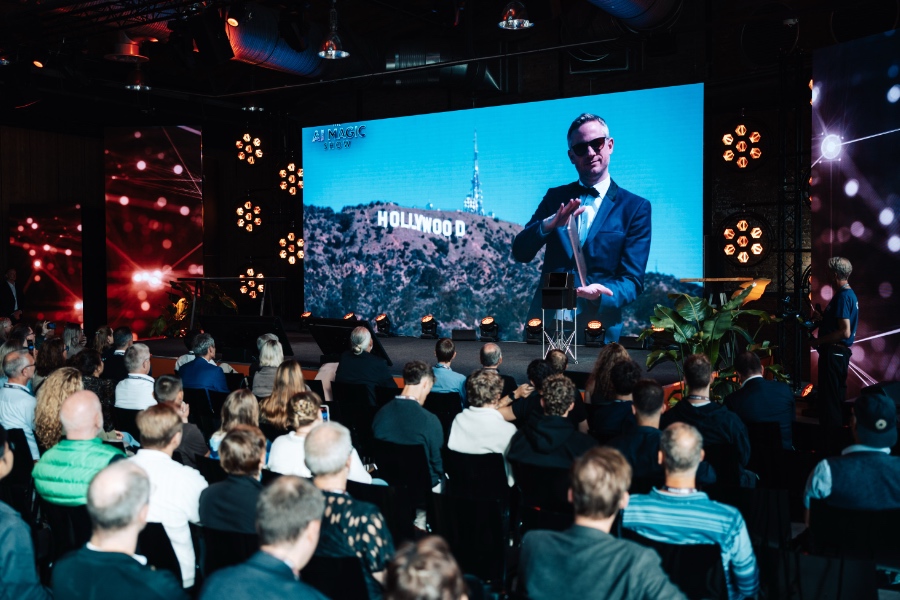
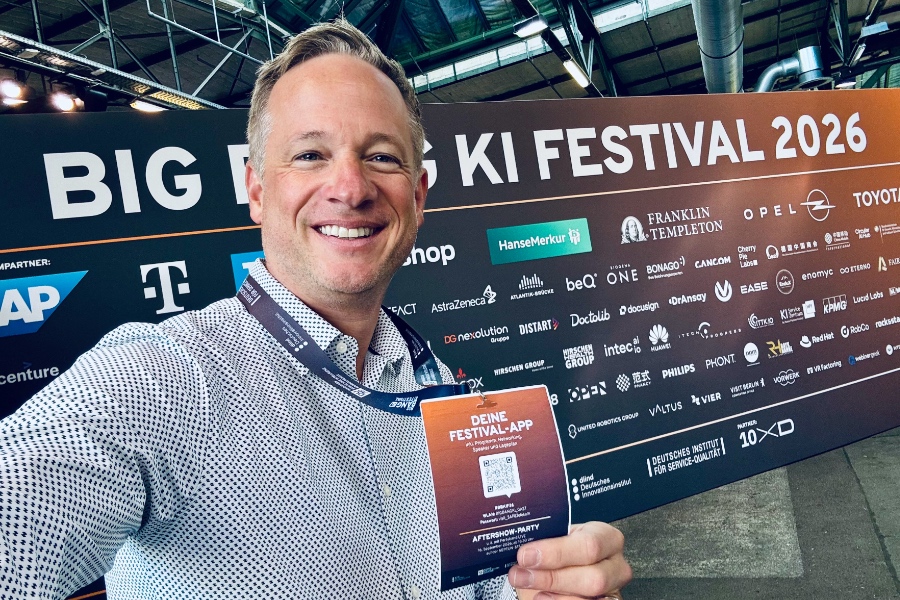
And right in the middle of it all, at the BIG BANG KI Festival 2026 in Berlin, I got to do what I love most: use new technology for things it probably wasn’t designed for.
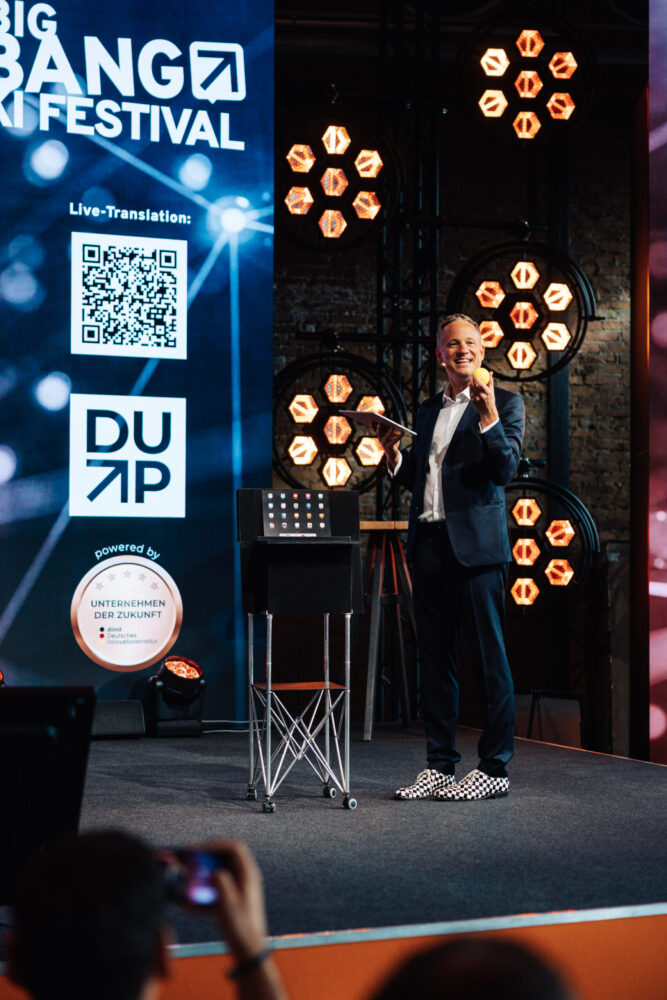
On the Jupiter Stage, I presented my AI Magic Show.
It was a surprisingly good fit for a festival where almost everything else revolved around what artificial intelligence can already do today – and what it will do to our working world tomorrow.
For me, the connection is fairly obvious.
I have been using new technologies for magic for many years. When the iPad came out, I started developing my own apps specifically for my shows. Later came augmented reality, robotics and other technologies.
Not because technology on stage is automatically exciting. Most of the time, it isn’t.
For me, it only gets exciting when technology does something nobody expected.
And that is exactly why AI is such an interesting playground for a magician.
As a magician, I deal professionally with the boundary between the possible and the impossible.
Artificial intelligence is shifting exactly that boundary right now.
Things that sounded like science fiction just a few years ago are now done in passing on a smartphone. Images are created from a single sentence. Software holds conversations. Machines create videos, write programs and develop ideas.
We get used to it quickly – and perhaps that is exactly why wonder is so important.
Not because we should celebrate every new technology without questioning it. But because curiosity is usually a pretty good starting point for engaging with change.
After all, what we probably need right now are fewer people claiming to know exactly what the next ten years will look like.
We need more people who are keen to help shape them.
I, for one, will keep exploring what happens when you combine artificial intelligence with magic.
And if, at the end of the day, even at an AI festival full of tech experts, someone stands in front of me and says, “That can’t be possible”…
…then it was a good evening.
“With his AI Magic Show, Simon Pierro impressively demonstrated how fascinating, surprising and entertaining artificial intelligence can be. A brilliant mix of magic, technology and entertainment that thrilled our audience and left many faces full of amazement. A real highlight of the BIG BANG KI FESTIVAL!”
Christian Schlieker, Director Communications & Content, DUP Media GmbH (translated from German)
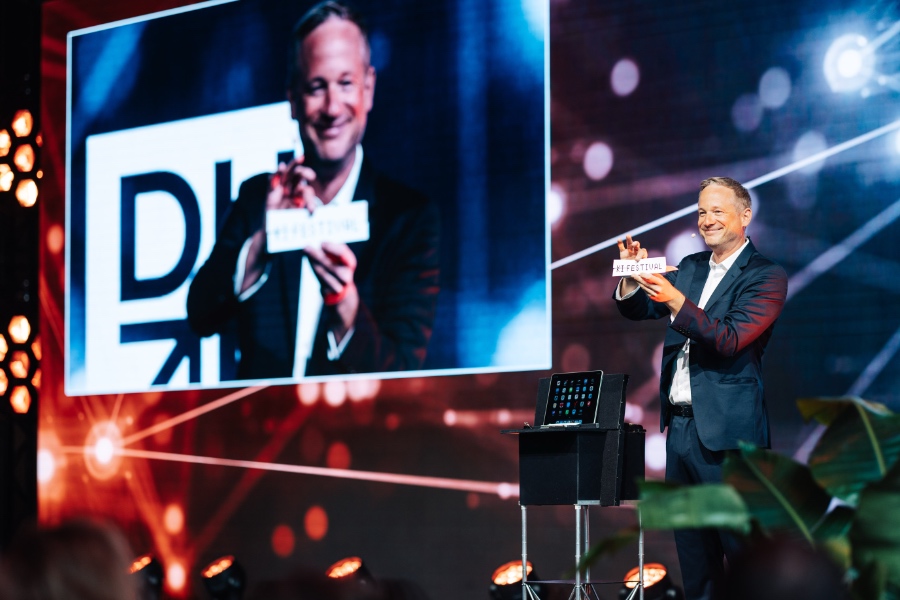
Mr Pierro, you earn your living with illusions. Is AI currently the economy’s greatest illusion – because many companies confuse progress with simply using new tools?
As a magician, I first have to stand up for the word illusion a little: illusions are something wonderful. Mine are, at least.
It becomes problematic when you mistake an illusion for reality.
Put differently: with AI, the illusion isn’t the technology itself, but the belief that a new tool automatically means progress.
It’s a bit like buying a magic set and assuming that it will automatically enable you to thrill an audience without any rehearsal.
A magic set doesn’t make you a magician. But it’s a pretty good start.
You work with AI while others are still debating its benefits. What have you understood that many business owners haven’t yet?
I don’t know whether I’ve understood more than others. But as a magician who works with technology, I’ve always had the luxury – and to some extent the necessity – of looking for new inspiration very early on. While many magicians travel to Las Vegas for professional development, I tended to fly to Silicon Valley.
There, in 2016, I met Adam Cheyer, one of the minds behind Siri and Viv, among others, and saw where artificial intelligence could go. I was so fascinated that in the same year I performed my first AI-themed show at corporate events.
As a magician, I try to cultivate a playful and creative approach to new technologies. I call it Artistic Intelligence. For a magician, technology could of course simply be a hidden trick principle. For me, though, it is deliberately at the front end of the magic. I look at what it can do and what it can’t. And then I make the latter possible.
Entertainment has a big advantage here: people first and foremost want to be entertained – and ideally only realise afterwards that they have become curious, lost their inhibitions and found a whole new way into AI.
Almost every company is experimenting with AI. But where does it actually create new business – rather than just a more efficient old process?
Of course, I also try to use AI to become more efficient in preparing and delivering my shows. But it only gets really exciting for me when it enables new illusions or entirely new forms of staging.
That’s not so easy, though, because AI is changing the audience’s expectations at the same time. Things that would have seemed completely impossible just a few years ago are now quickly explained away with “That was surely AI” – sometimes even with illusions I have been performing for over ten years.
For me, innovation therefore doesn’t mean simply building AI in somewhere. It has to change the experience itself and allow me to bring something to the stage that I couldn’t do without it. At the same time, I still have to manage to surprise the audience with it.
Which business idea is AI making possible for the first time today that you would have considered science fiction three years ago?
If I knew that for sure, I probably wouldn’t be teaching a robot magic right now – I’d be founding a start-up. For twenty years as an entertainer, I have repeatedly simulated things I thought technology should be able to do one day. When I pour real beer from an iPad, that is, of course, still magic.
But with AI, something astonishing is happening: things I would have staged as an illusion just a few years ago suddenly actually work. An AI can talk to the audience, respond to people and generate content in real time. That opens up entirely new forms of entertainment and interaction.
I used to try to anticipate the future of technology through magic. Today, I sometimes have to think about how to make reality more magical than technology again.
A good magic trick works because you understand human behaviour. Why is exactly that becoming more important than technical know-how in the age of AI?
Because of my job, I’m naturally interested in what AI can do. But I’m even more interested in what happens to people when they experience what AI can do.
A magician is constantly dealing with people anyway. The technology is just a means to an end. I need to understand where someone is looking, what they expect, what surprises them and when they trust me.
With AI, exactly that is becoming more and more important. The best technology is of little use if people are hesitant, don’t trust it or see no personal benefit in it. That’s why I integrate AI into my shows in a way that lets people marvel and laugh – and perhaps, almost in passing, find a new way into it.
AI can now create deceptively real images, voices and personalities. What value does trust have as a resource in the digital economy?
As a magician, I’m surprisingly transparent here, by the way: I promise a deception – and I deliver it.
With AI, it is often no longer clear what is real and what isn’t. Images, voices and even entire personalities can be generated artificially today. That’s precisely why trust will probably become one of the most important currencies of the digital world.
And interestingly, this is also making live magic massively more valuable again. The less we trust camera images, the more what we experience directly in front of us gains a whole new quality. When a magician makes something impossible happen on a stage just a few metres away and you share the reaction of the whole room, it creates a sense of wonder that can’t simply be explained away as an AI-generated video.
Magicians have to surprise their audience. Companies, on the other hand, often try to avoid mistakes. Why is this safety culture Germany’s biggest innovation problem?
For a magician, too: perfection should be the goal, but not the starting point.
The trick obviously has to work on stage. But whether it’s really good, I only find out from people’s reactions: Are they amazed? Are they laughing? Does the moment work? The craft has to be solid, but optimisation happens in front of an audience. So I, too, have to push myself to try out new ideas and leave my comfort zone.
That’s often how it works in the American tech world, by the way: software comes onto the market and is improved through updates. You just have to call it a beta, to be on the safe side.
What sets an AI magician apart from classic magicians like David Copperfield or Siegfried & Roy?
With classic magicians, the main question is: how did he do that? With me, there’s now a second question as well: who actually did it – the magician or the machine?
I always try to meet the audience where their interests and everyday lives are. Instead of a mysterious box with mirrors and a false bottom, for example, I have an iPad on stage. These are technologies everyone knows, and where the audience believes they know pretty well what they can and can’t do.
So essentially, I just package illusions differently. The rules of good magic remain similar: you play with expectations, direct attention and try to create a moment nobody saw coming.
The technology changes. The feeling of wonder doesn’t.
You need to load content from reCAPTCHA to submit the form. Please note that doing so will share data with third-party providers.
More Information